

TL;DR:
- Global Oversight: The FATF and OECD have pivoted from “paper compliance” to testing the real-world operational effectiveness of financial entities.
- Reputational Currency: Credibility is the primary asset for Mauritian firms; a single failure triggers de-risking by international correspondent banks.
- Beyond Local Rules: Meeting global standards requires a framework that anticipates international audit pressure before it reaches crisis levels.
- Evidence-Based Integrity: Strategic consultancy provides the independent verification necessary to satisfy the world’s most demanding regulators.
In an era where your “Social Licence” to operate is granted by global stakeholders, ensure your governance is bulletproof with an LSCL Strategic Review.
Meeting Global Standards: The Cost of Credibility
Mauritius’ status as a global financial hub is contingent upon its response to heightened international scrutiny. Today, global watchdogs such as the Financial Action Task Force (FATF) and the OECD closely monitor the country’s financial practices to ensure transparency, accountability, and adherence to international standards.
In 2026, the stakes have evolved. The FATF sets benchmarks for anti-money laundering (AML) and counter-terrorism financing (CFT), while the OECD enforces tax transparency and fair competition principles. However, regional bodies like ESAAMLG now reinforce these expectations by testing the “Effectiveness” of local frameworks. Mauritius must continuously demonstrate compliance with these standards to maintain its credibility and avoid being placed on international watchlists or blacklists. For directors, this requires businesses operating within the jurisdiction to adopt robust compliance frameworks that go beyond local regulations, ensuring they can withstand a high-pressure international audit.
Why International Scrutiny Matters: More Than a Legal Risk
Global investors and regulators expect Mauritius to uphold the highest standards of integrity. In the current climate, international scrutiny is not merely a legal hurdle—it is a significant business threat that can lead to de-risking by global financial institutions.
Non-compliance can lead to severe consequences, including:
- Correspondent Banking Atrophy: Reduced access to international clearing houses, making cross-border transactions slower, more expensive, or simply impossible.
- Loss of investor confidence: Institutional capital is highly sensitive to “Grey List” triggers and flees at the first sign of jurisdictional friction.
- Reputational damage: In a world where financial centers are under constant observation, a single breach impacts both the individual firm and the jurisdiction’s standing.
- Strategic Financial Risk: While local administrative fines exist, the true cost lies in the restrictions on cross-border transactions that can paralyze a firm’s ability to operate.
Maintaining compliance is therefore not just a regulatory obligation—it is a strategic necessity for businesses seeking to thrive in Mauritius’ competitive financial sector.
Moving from “Paper Compliance” to “Live Evidence”
To survive international scrutiny, Mauritian firms must transition from static procedures to dynamic evidence. This requires a deep dive into Immediate Outcomes (IOs) as defined by the FATF. It is about proving that your firm actually understands its specific risk appetite and can demonstrate a history of flagging suspicious activity before it hits the global system.
This “Live Evidence” model focuses on:
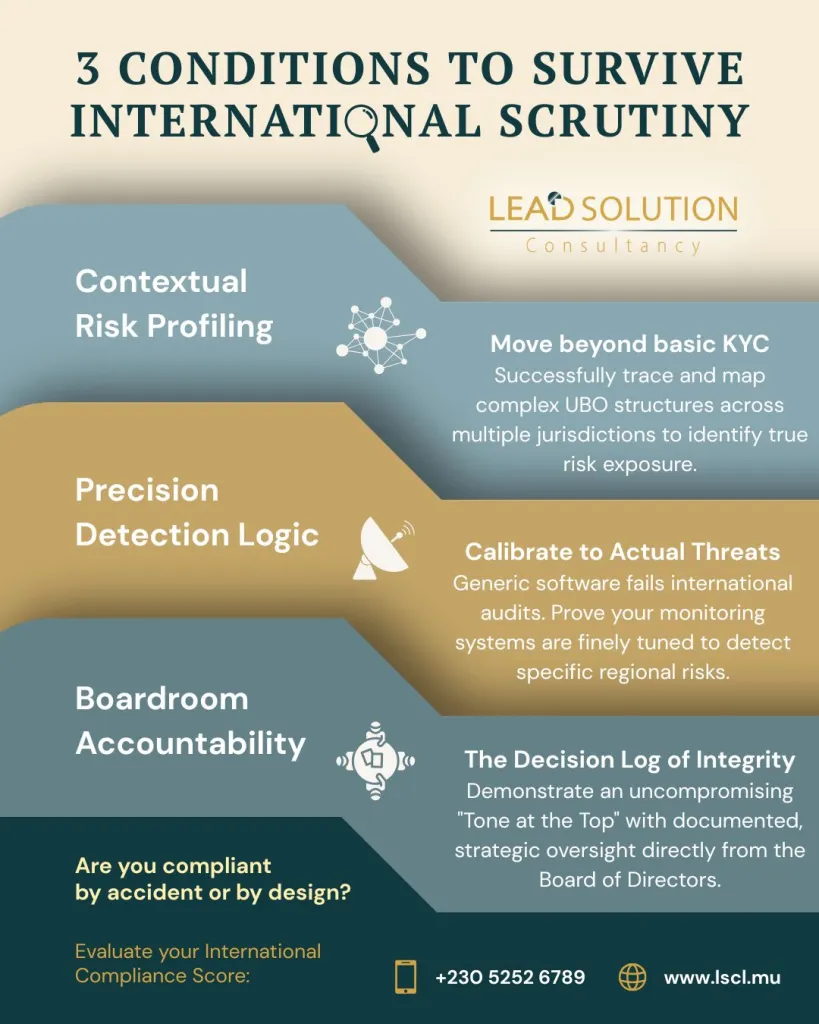
- Contextual Risk Profiling: Going beyond generic KYC to map complex UBO (Ultimate Beneficial Owner) networks across multiple jurisdictions.
- Detection Logic: Proving that your monitoring systems are calibrated to the actual threats present in the Mauritian corridor, such as specific trade-based money laundering risks.
- Board Accountability: Demonstrating that the “Tone at the Top” is backed by a clear decision log of compliance oversight, moving governance from the back-office to the Boardroom.
The Role of Compliance Consultancy Firms
Strategic compliance consultancy bridges the gap between international mandates and local operational reality. At LSCL, we act as the bridge between international expectations and local operational reality. We ensure your company is “not compliant by accident” by providing a “Decision Log of Integrity” through:
- Strategic Policy Development: Crafting AML/CFT policies and governance manuals aligned with the latest FATF and ESAAMLG recommendations to ensure they stand up to international audits.
- Risk-Based Gap Analysis: Identifying vulnerabilities in beneficial ownership transparency to protect your firm’s standing before an international evaluation.
- Training & Awareness: Equipping the Board and Senior Management with the knowledge to detect and prevent financial crime, ensuring that governance is a lived reality.
- Effectiveness Monitoring: Conducting independent reviews to verify that internal controls are not just present, but effective under the pressure of international scrutiny.
Mandating independent reviews provides the evidence of integrity required by international stakeholders.
Building Trust Through Compliance: A Strategic Asset
In a world where financial centers are under constant observation, Mauritius must continue to strengthen its regulatory framework. Compliance is no longer a cost center; it is the foundation of sustainable growth and investor attraction. In 2026, international scrutiny is the filter that separates resilient, global players from the rest.
Compliance consultancy firms provide the expertise and guidance needed to meet international expectations, safeguard reputations, and build lasting trust with global partners. By investing in expertise, companies position themselves as responsible, transparent, and resilient players in the global financial market. Trust is not given; it is built through consistent, proven adherence to the world’s highest standards of governance.
Contact LSCL today to evaluate your International Compliance Score